
Surprising opening: a single mis-signed approval is still one of the fastest ways to lose a six-figure crypto position, and yet most browser wallets still leave users guessing about the precise token and fee effects of a click. Rabby positions transaction simulation and pre-signing risk scans as an operational fix to that gap. For DeFi power users—traders, LPs, and multi-sig teams who move significant capital and who interact with dozens of contracts across chains—this is not a cosmetic feature. It changes the practical checklist you run before every confirmation and therefore alters the wallet threat model you must manage.
In this article I take a case-led approach: walk through a realistic US-based DeFi workflow (portfolio aggregation across networks, cross-chain gas top-up, interacting with a new AMM listing), explain how Rabby’s mechanisms work, compare trade-offs against common alternatives, and surface the gaps you still need to close with operational discipline and additional tooling.
How Rabby’s simulation and pre-signing engine actually work (mechanisms)
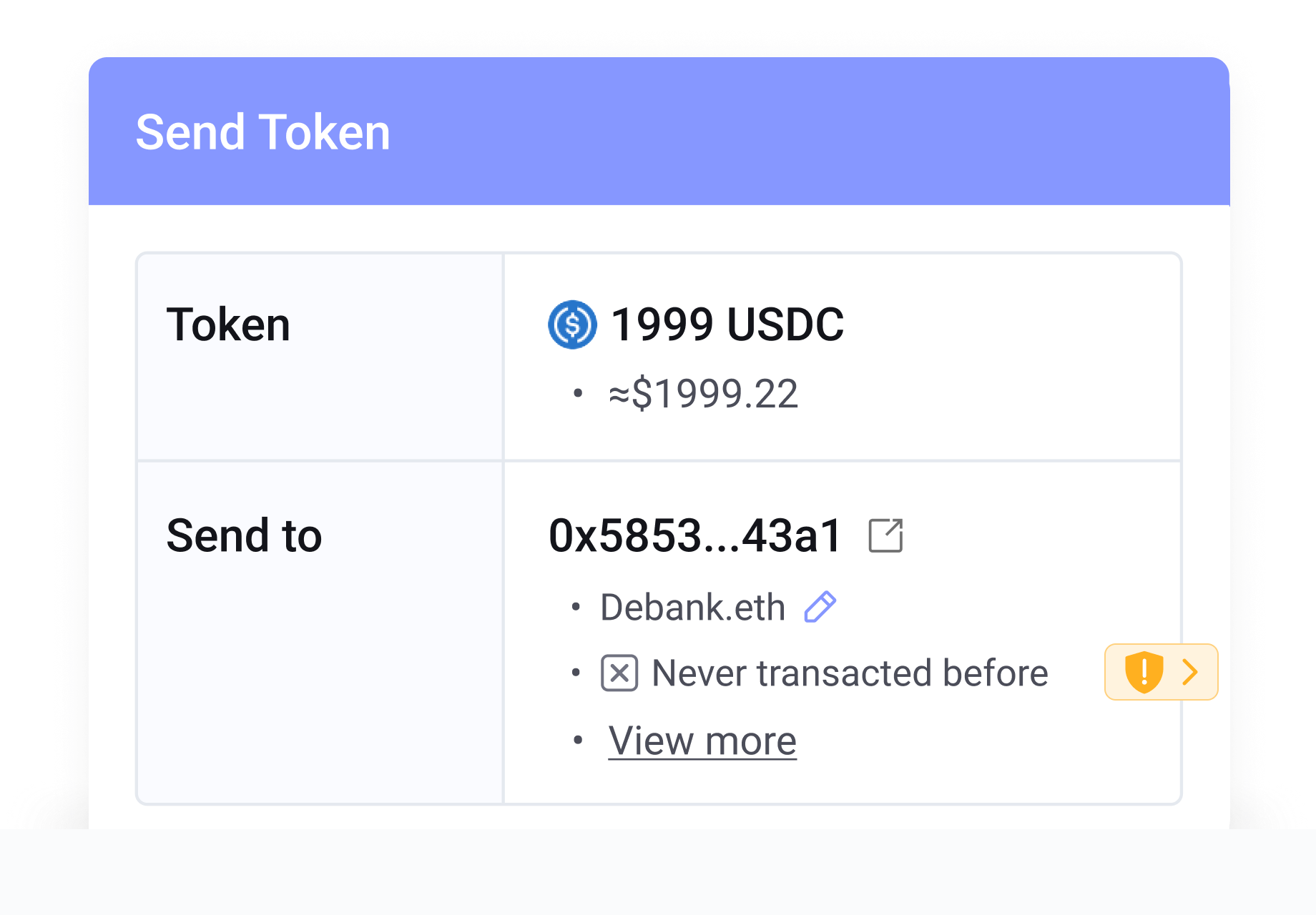
At its core, Rabby runs a local simulation of the transaction you’re about to sign and surfaces the expected token balance changes and gas costs before you approve. Mechanically, that means the extension queries the connected network (or an RPC provider), constructs the transaction call as the dApp would, executes it against a node in read-only mode, and parses state diffs to present a human-readable summary. This prevents “blind signing” — approving a transaction without knowing who will get what, or whether an approval is actually an infinite allowance cloaked as a one-time call.
Crucially for power users, Rabby layers an additional rule-based risk scanner over those simulations. The scanner flags known-bad contract addresses (previously hacked or reported), suspicious patterns (e.g., token approvals that set allowances to MAX_UINT), and anomalies like transfers to zero or burn addresses. The wallet then displays warnings and lets the user cancel or proceed. Because Rabby is open-source under MIT, security researchers can and do review the scanner rules and the simulation logic; that transparency is a practical advantage in risk-sensitive environments.
Case: cross-chain swap where gas is missing — a practical walkthrough
Imagine you hold ETH on Ethereum mainnet and want to swap on an Arbitrum-based AMM, but you have zero ARB to pay fees. Rabby’s cross-chain gas top-up lets you send small amounts of gas from your preferred chain to Arbitrum within the wallet flow so the swap can proceed. Mechanistically, the wallet helps construct and sequence two on-chain actions (a cross-chain transfer and the target swap); it simulates both and shows net balances and fees. That eliminates a class of user error where people sign the swap but forget to fund gas, then panic and execute risky approvals to work around it.
Trade-off: convenience versus surface area. Combining cross-chain funding with swaps reduces friction but increases the number of atomic steps and the attack surface for social-engineering or malicious dApp flows. Rabby mitigates this with explicit step-by-step confirmations and the simulator, but it cannot eliminate risk entirely: users must still verify destination chains, token contract addresses, and third-party dApp reputations.
Where Rabby helps institutions and where it still needs external support
For institutional use-cases, Rabby integrates with custody and multi-sig solutions like Gnosis Safe, Fireblocks, Amber, and Cobo Wallet. That matters because multi-sig and enterprise MPC systems close the biggest custody gap: they prevent a single compromised seed from authorizing high-value moves. In practice you’d use Rabby as the UX layer for interacting with dApps while your treasury keys remain under multi-sig control. This hybrid model is sensible: strong UX plus hardened key custody.
But limitations remain. Rabby does not provide native in-wallet staking or a fiat on-ramp—so institutions that want a single vendor for custody, fiat settlement, and staking will still need additional providers. Likewise, the 2022 Rabby Swap exploit reminds us that even wallets with sophisticated defenses can be connected to vulnerable smart contracts; the team’s response then (freezing the contract and compensating users) is evidence of operational responsibility, but it’s not a preventive guarantee for future third-party contract exploits.
Comparing alternatives: what you gain and what you give up
Compared with MetaMask, Trust Wallet, or Coinbase Wallet, Rabby’s distinguishing features are the transaction simulator, automatic network switching, and a built-in approval revocation panel. Those are concrete security upgrades for power users who frequently approve contracts. The cost is marginally more interface complexity and a reliance on Rabby’s scanner rule set: no scanner is perfect, and false negatives are possible. Rabby reduces human error but doesn’t replace good operational hygiene—hardware wallets and multi-sig remain essential for significant sums.
Another practical distinction is hardware-wallet and platform support: Rabby supports Ledger, Trezor, Keystone and others, and it runs as a Chromium extension, desktop client, and mobile app. That flexibility helps teams that split activity between a secure office workstation and on-the-go approvals. The “Flip” toggle to swap back to MetaMask as default is a small but useful ergonomics win for users migrating workflows incrementally.
Decision-useful framework: when to pick Rabby and how to layer defenses
Heuristic: if you sign many complex DeFi transactions daily, especially on less-reviewed chains, Rabby is worth testing for its simulation and approval tools. But adopt it under a layered-security model:
– Primary custody: keep large reserves in cold storage or multi-sig (Gnosis Safe / Fireblocks).
– Interaction wallet: use Rabby for day-to-day dApp interactions, with hardware wallet integration for signing high-value operations.
– Pre-approval hygiene: always inspect the simulated balance deltas and recipient addresses Rabby shows; treat a green “no risk” scanner output as informative, not dispositive.
– Revocation cadence: periodically use Rabby’s approval revocation tool to remove idle allowances; consider automation scripts or bots for high-frequency revocation if your workflow generates many approvals.
FAQ
Is Rabby completely secure because it simulates transactions?
No. Simulation reduces one major class of risk—blind signing—by showing expected effects before you approve. But it doesn’t prevent smart contract vulnerabilities, RPC manipulation, or social-engineered prompts on compromised websites. Think of simulation as a powerful safety layer, not a single-point solution.
Can I use Rabby with hardware wallets and multi-sig setups?
Yes. Rabby supports major hardware devices (Ledger, Trezor, Keystone, etc.) and integrates with institutional tools like Gnosis Safe and Fireblocks. For high-value operations, combine Rabby’s UX with multi-sig custody to minimize single-key risk.
Does Rabby support all chains and in-wallet fiat purchases?
Rabby supports over 90 EVM-compatible chains, including Ethereum, Arbitrum, Optimism, Polygon, BNB Chain, and Avalanche. However, it currently lacks a built-in fiat on-ramp and native staking features, so you’ll need third-party services for those functions.
What to watch next (signals that matter)
For US-based DeFi power users, three signals should drive whether Rabby becomes a default tool in your stack: expansion of scanner threat feeds (broader, community-curated lists of compromised contracts), tighter integrations with institutional custody providers for seamless multi-sig UX, and improvements in RPC integrity (to prevent node-level manipulation of simulations). Any one of these developments would materially raise the practical security Rabby provides. Conversely, an exploit of a widely used Rabby-connected contract—or a supply-chain issue in popular RPC providers—would show the remaining systemic fragility and remind users to keep layered protections.
Finally, if you want to try the extension and follow its documentation and audits, start conservatively: import a test wallet, connect to small amounts, compare simulated outputs to actual on-chain results, and then migrate higher-value workflows. For a canonical resource and download hub, see the official Rabby page: rabby wallet.